

How to Choose Your First Acoustic Guitar: 2026 Guide
Last Updated: October 24, 2026
Quick Summary
To choose your first acoustic guitar, start with how you plan to play it, then match the size and string type to your hands and goals. Budget for the full cost, including a setup, case, and accessories, not just the instrument. Sit with the guitar before buying and inspect the action, frets, and tuning stability.
- Full-size dreadnoughts suit most adults, while smaller bodies help shorter arms reach the strings cleanly.
- Steel-string guitars suit pop, rock, and country; nylon-string guitars suit classical and softer fingerstyle.
- A realistic budget covers guitar, setup, case, accessories, and lessons, not just the instrument.
- A professional setup lowers the action, corrects intonation, and polishes fret ends.
- If you buy online, inspect the guitar within the return window, not after.
Table of Contents
- Start With Your Intended Use and Playing Style
- Acoustic Guitar Sizes for Beginners: Finding Your Fit
- Steel-String vs. Nylon-String Guitar: Which Should You Pick?
- How Much to Spend on a Beginner Guitar
- Acoustic Guitar Action for Beginners: Why Playability Matters
- Tonewoods, Body Shape, and the Sound You Want
- In-Store Inspection Checklist for Your First Acoustic Guitar
- Buying Online vs. In-Store: Returns, Setup, and Total Cost
- Frequently Asked Questions
Start With Your Intended Use and Playing Style
The best way to choose your first acoustic guitar is to start with how you plan to play it, not how it looks on the wall. A strummer's guitar differs from a fingerpicker's.
Ask yourself three questions first:
- Will you strum chords or pick out melodies?
- Do you want to play standing with a strap or seated?
- Will you record at home or perform live?
Your answers shape everything below. A strummer wants a dreadnought's volume; a fingerpicker wants a smaller body and wider string spacing. Recording later just needs a simple interface, like a guitar-to-USB interface cable that plugs into a laptop.
Acoustic Guitar Sizes for Beginners: Finding Your Fit
Acoustic guitar sizes for beginners come down to comfort, not age. If the guitar feels too big, you will play less. Full-size suits most adults; smaller bodies help younger players or shorter arms reach the strings cleanly.
Here is how the common sizes compare:
Size |
Best For |
Scale Length |
Comfort Level |
|---|---|---|---|
Full-size (dreadnought) |
Most adults |
Long |
Big volume, larger reach |
Grand concert / OM |
Smaller adults, fingerstyle |
Medium |
Easier to hold |
Three-quarter |
Teens and small adults |
Shorter |
Easy reach, less volume |
Half-size |
Children |
Short |
Light and manageable |
Scale length is the distance from nut to bridge. A shorter scale means less string tension and easier fretting for small hands.
Steel-String vs. Nylon-String Guitar: Which Should You Pick?
Steel-string guitars suit pop, rock, and country; nylon-string guitars suit classical and softer fingerstyle. Steel sounds brighter and louder but is tough on new fingers, though it cuts through a mix and handles a pick well.
Pick based on your music:
- Strumming with a pick: steel-string
- Classical or fingerstyle: nylon-string
- Easiest on new fingers: nylon-string
If you go steel-string, string gauge matters too. You can pick up a set of Acoustic Guitar Strings for a six-string acoustic. Lighter gauges feel easier to press.
How Much to Spend on a Beginner Guitar
How much to spend on a beginner guitar depends less on the sticker price than on the total cost of a playable instrument. Most beginners budget for the guitar and forget the case, tuner, strings, setup, and lessons.
A realistic first-guitar budget has five lines, not one:
Cost Line |
What It Covers |
Typical Range (CAD) |
|---|---|---|
Guitar |
The instrument itself |
$150-$500 |
Setup |
Action adjustment, intonation, fret check |
$60-$120 |
Case or gig bag |
Padded bag or hard case |
$40-$150 |
Accessories |
Tuner, strap, picks, capo, spare strings |
$40-$90 |
Lessons |
A few months of guided instruction |
$80-$200 |
Those ranges are typical; exact prices vary by brand, model, and retailer, so confirm current listings. The point is that a guitar plus a setup plus a case plus accessories is a larger decision than just the instrument itself.
Why the setup line matters most
A new guitar from a factory or big-box store often ships with high action and rough fret ends. A professional setup lowers the action, corrects intonation, and polishes fret ends. Skipping it can make the instrument feel hard to play, potentially impacting motivation. Budget for it up front, or confirm the seller includes one.
Where to spend and where to save
- Spend on: a straight neck, working tuners, and a solid top. These affect playability and tone more than cosmetics.
- Save on: fancy inlays, gloss finishes, and brand premiums. They do not make the guitar easier to play.
- Skip for now: effects pedals, recording gear, and a second guitar. Add them once you know you will keep playing.
Financing and free-shipping thresholds
If spreading the cost helps, ask about financing terms, but read the interest rate and total repayment, not just the monthly figure. Also check the free-shipping threshold: bundling the case and accessories into one order can save delivery cost. Confirm the current threshold on the retailer's site, since it changes.
Acoustic Guitar Action for Beginners: Why Playability Matters
Acoustic guitar action for beginners is the most overlooked spec. Action is the height of the strings above the fretboard: high action makes fretting painful, while low action plays easy but can buzz if set too low. Playability decides whether you keep going; comfortable action and a smooth neck feel inviting, high action feels like a chore.
Check these playability points:
- Action height: strings should press down without a fight
- Neck profile: a slim, rounded neck suits smaller hands
- Fretboard edges: smooth, no sharp ends
Tonewoods, Body Shape, and the Sound You Want
Tonewoods shape the sound you hear. Spruce tops give bright highs and strong projection; mahogany and sapele lean warmer, with rich lows and a rounder tone.
Here is how the main options sound:
Buy Your First Acoustic Guitar →
Top Wood |
Tone Character |
Good For |
|---|---|---|
Spruce |
Bright, loud, clear |
Strumming, all-round |
Mahogany |
Warm, focused |
Blues, fingerstyle |
Sapele |
Balanced, slightly bright |
Budget all-rounders |
A dreadnought pushes out volume for strumming; a grand concert or OM keeps notes balanced for fingerpicking. Smaller bodies feel more comfortable but project less. Play a few if you can; no spec sheet replaces hearing it yourself.
In-Store Inspection Checklist for Your First Acoustic Guitar
A hands-on inspection catches problems a photo never shows. Run through this protocol before you pay for your first acoustic guitar, in a shop or after an online delivery arrives.
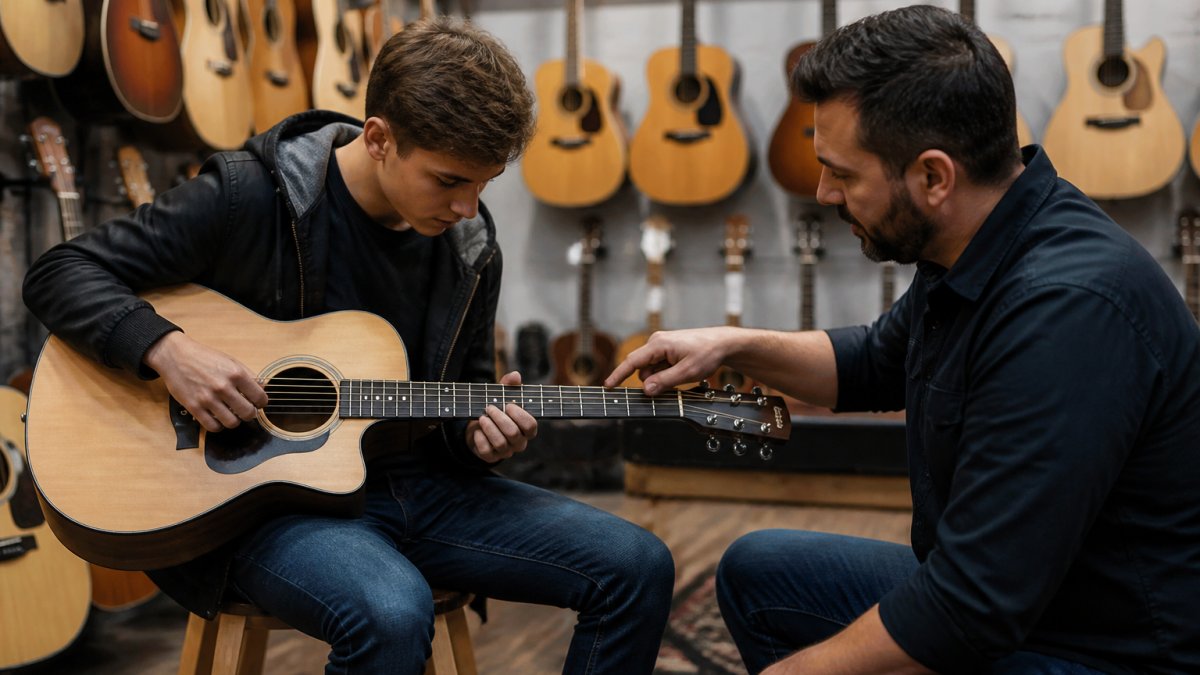
1. Sight the neck for straightness
Hold the guitar at eye level and look down the edge of the neck from headstock to body. The fretboard edge should look straight. A visible bow or twist means the relief is wrong or the neck is warped. A slight forward bow is normal and adjustable; a twist is a walk-away.
2. Run a finger along the fret ends
Slide your hand up and down both edges of the fretboard. Sharp fret ends, often caused by dry air during shipping, catch your skin. They are fixable with a file but signal careless finishing. Factor the cost of dressing them in, or choose another instrument.
3. Play every string at every fret
Fret each string one fret at a time from the first fret to the body joint and listen for buzz or dead notes. A buzz on one fret usually means a high fret or uneven action; a dead note means a fret is not seated. Play at normal volume; buzz often appears only then.
4. Check the action at the 12th fret
Press the low E string at the first fret and at the body joint, then check the gap at the 12th fret. A beginner-friendly target is roughly a medium pick's thickness on the high strings and slightly more on the low. If the strings fight back, action is high and needs a setup; if they rattle, it is too low.
5. Test tuning stability
Tune the guitar, bend each string a few times, play a chord, and recheck tuning. If a string drops noticeably, the tuner is slipping or the nut is binding. Smooth tuners that hold pitch after bending are a good sign; stiff or loose ones are not.
6. Check intonation at the 12th fret
Play the 12th-fret harmonic on a string, then fret the same note at the 12th fret. The pitches should match closely. If the fretted note is noticeably sharp or flat, saddle position or action is off. A small discrepancy is normal and adjustable; a large one suggests a setup or structural issue.
7. Inspect the body, bridge, and nut
Look for cracks in the top, back, and sides, especially around the bridge and soundhole. Check that the bridge is glued flat with no lifting edges and the nut is seated with no gaps. Loose braces rattle when you tap the top gently. Any crack or lifting bridge is a pass; walk away.
8. Confirm the electronics if present
If the guitar has a pickup, plug into an amp and test every control: volume, tone, and the built-in tuner. A dead pickup or scratchy control is a repair cost you should not absorb on a first guitar.
Once you have your guitar, protect it. A proper Gig Bag guards against knocks and dry air. Store it away from radiators and direct sun, and keep a hygrometer nearby if your home is dry in winter.
Buying Online vs. In-Store: Returns, Setup, and Total Cost
Buying online versus in-store comes down to trial and convenience. A store lets you try and hear the guitar first; online offers more choice and often better prices, but you cannot hold the instrument.
Weigh these factors:
- Try before buying: in-store wins
- Selection and price: online often wins
- Return policy: check the window carefully
At RedOne Music Canada, we help beginners match a guitar to their budget and playing style, with fast shipping and expert service. Check current prices and options on our site before you commit.
Choosing your first acoustic guitar is a series of small, practical decisions: playing style, size, strings, and budget. Get those right and you will pick an instrument you actually want to play.
Frequently Asked Questions
Should a beginner choose a steel-string or nylon-string acoustic guitar?
It depends on the music you want to play. Steel-string guitars suit strumming, folk, pop, and rock, and they project louder with bright highs. Nylon-string guitars have softer tension and wider necks, which many beginners find easier on the fingertips, and they suit classical and fingerpicking styles. Try both in a store if you can. If your heart is set on singer-songwriter material, a steel-string is the more versatile first acoustic guitar.
How much should a beginner spend on an acoustic guitar?
Plan for a guitar that plays comfortably and stays in tune rather than the cheapest option available. Pricing depends on brand, materials, and setup, so check RedOne Music Canada's website for current prices. Budget separately for essentials: a tuner, a case or gig bag, a strap, and possibly a professional setup. A well-set-up budget guitar can serve you better than an expensive one with high action that hurts to play.
What size acoustic guitar is best for adult beginners?
Most adults fit a full-size guitar with a scale length around 25.5 inches, but comfort matters more than convention. If you have smaller hands or a shorter reach, a three-quarter-size or concert-body guitar can make chords easier. Sit with the guitar and check that your fretting hand can reach the first fret comfortably and your strumming arm rests naturally over the body. The best acoustic guitar sizes for beginners are the ones you can hold without strain.
What should I check when buying my first acoustic guitar?
Inspect the neck for twists and sharp fret ends, play every string at every fret to listen for fret buzz, and check the action height at the 12th fret. Tune the guitar and see whether it holds pitch after a few minutes of playing. Look for cracks or lifting glue joints, and confirm the bridge and nut are secure. Ask whether a setup is included. Buying online works if the return policy covers adjustment issues.

No comments yet
Be the first to share your thoughts on this article.
Leave a comment
Ready to find your sound?
Explore our wide selection of instruments, gear, and accessories. Whether you're a beginner or a pro, we've got what you need.